


Our mission is to support local researchers in developing locally grounded, evidence-based solutions to hunger and malnutrition in Latin America and the Caribbean.
Two paradoxes motivate LENS

PARADOX 1
Latin America and the Caribbean is the world’s largest net food-exporting region and produces more than enough food to feed its population.
Yet 1 in 4 people in the region are food insecure.
PARADOX 2
Latin America and the Caribbean needs locally grounded research to address these challenges.
Yet the region accounts for only 2% of global R&D investment.

«Local researchers have firsthand knowledge of the local context, can share findings directly with local policymakers, and can make research more cost-effective and sustainable. However, they often lack even modest resources to conduct research.»
— Ann Mitchell, Founder and Executive Director, LENS
What is LENS?
Local Evidence for Nutrition Solutions (LENS) is a US-incorporated non-profit organization that works to build regional research capacity to generate locally grounded, policy-relevant evidence on hunger and malnutrition in Latin America and the Caribbean. LENS is funded by contributions from individuals and foundations.
LENS is supported by a team of technical advisors on our Advisory Committee and an Executive Board.
LENS acts as a catalyst, enabling local researchers to generate evidence and develop solutions grounded in the realities of their own communities.
What we do
01
Fund Research
Through small competitive research grants for university researchers based in Latin America and the Caribbean
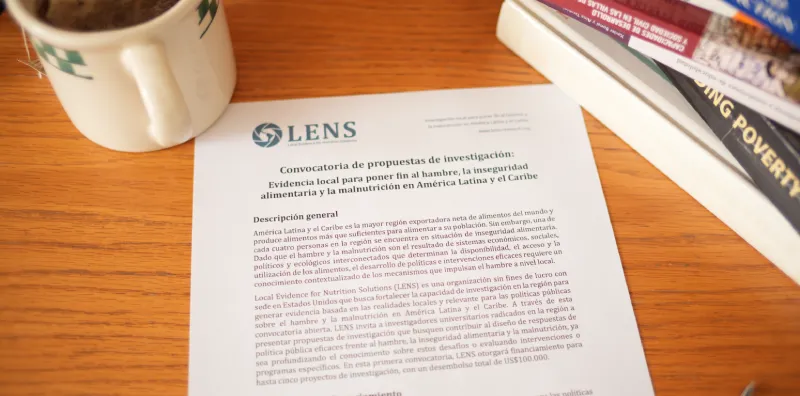
Call for proposals.

02
Provide Research Support
By facilitating access to research tools technology and mentoring

03
Connect Researchers and Policymakers
Through stakeholder workshops, webinars, policy forums, and networking activities

04
Synthesize and Disseminate Evidence
Through newsletters, policy briefs, media outreach and participation in systematic reviews
Why local evidence?
Local context matters. Hunger and malnutrition are shaped by interconnected economic, social, institutional, political, and environmental factors. Understanding these factors requires research grounded in the realities of specific countries and communities.
- LAC is highly diverse. The region encompasses different geographies, populations, economies, institutions, and food systems. The factors contributing to hunger and malnutrition and the policies needed to address them vary across countries and communities.
- Effective policies require an understanding of the local context. Interventions must be adapted to the specific institutional, environmental, logistical and economic conditions governing how food is produced, distributed, accessed, prepared and consumed.
- The region is underrepresented in global research investment and knowledge production. Significant gaps remain in the data and evidence needed to assess nutritional status and evaluate interventions addressing hunger and malnutrition in the region. See Mitchell (2026) on inequality in global knowledge production.
- Local challenges can be overlooked. Research funding often favors high-visibility questions, leaving fewer resources for research that examines localized challenges or evaluates the effectiveness of local innovations.
“Reducing the Cost of a Healthy Diet (CoHD) requires context-specific policies rather than uniform solutions.” The FAO, 2026 State of Food Insecurity and Nutrition in the World